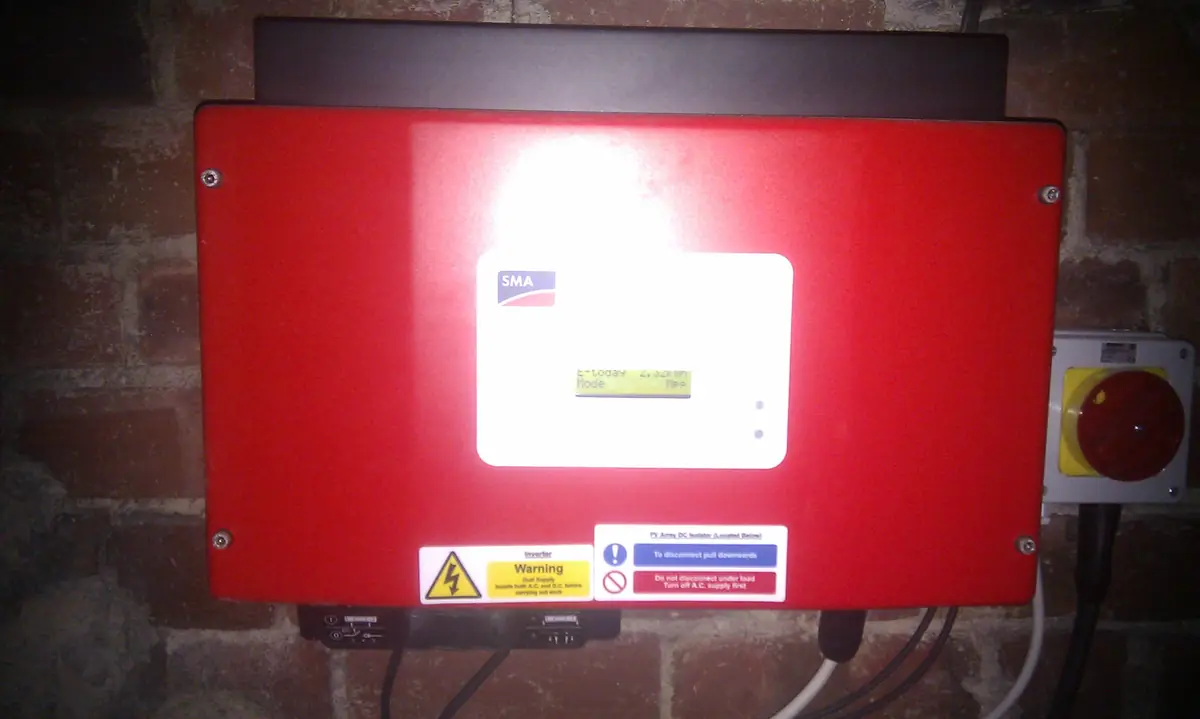
You can add a battery to existing solar panels without replacing them, and for most homes it is a one-day job with no scaffolding. We fit 5 to 10kWh batteries to systems of any age from £3,995, with VAT at 0% until 31 March 2027. If you are still paid under the Feed-in Tariff, we design the install so those payments carry on.
- From £3,995 for a 5 to 10kWh battery retrofit
- 1 day for most installs, with no roof work
- FIT kept: payments continue when the battery is set up correctly
- 0% VAT on batteries added to existing solar
Why add a battery now
Most homes with panels but no battery export a large share of what they make, often while nobody is in, then buy power back in the evening. With import at 26.32p per kWh under the October to December 2026 price cap, and many export rates well below that, the gap is where a battery pays. If your panels were fitted under the Feed-in Tariff, you are also likely paid for export on a deemed basis, a fixed share of what you generate, whatever you actually export. In that case every kWh you store and use yourself is pure saving: the deemed payment does not drop.
AC coupled or DC coupled
There are two ways to connect a battery to an existing system, and the right one depends on your inverter and your tariff.
AC coupled
The battery gets its own inverter and connects on the AC side, at your consumer unit, alongside the existing solar inverter. Your panels, wiring and generation meter stay exactly as they are. This is the usual choice for older systems and for anyone on the Feed-in Tariff, because the FIT generation meter carries on measuring only the panels.
DC coupled
The existing solar inverter is replaced with a hybrid inverter that runs both the panels and the battery. It is slightly more efficient, since solar power goes into the battery without being converted twice, and it is a good option when the old inverter is near the end of its life anyway. It needs more care on FIT systems, because the generation meter must still record only solar output.
| AC coupled | DC coupled | |
|---|---|---|
| Existing inverter | Kept | Replaced by a hybrid |
| Best for | FIT systems, newer inverters, simple retrofit | Old or failing inverters, non-FIT systems |
| Efficiency | Slightly lower | Slightly higher |
| Disruption | Minimal, no change to solar side | Solar side rewired at the inverter |
Keeping your Feed-in Tariff
Adding storage does not end your FIT. Ofgem's guidance is clear that deemed export payments continue after a battery is added, provided the generation meter still measures only the output of the accredited solar system. So we connect the battery where it cannot pass power through the generation meter, and give you a note of the work to send to your FIT licensee, which you must tell about the change. If you are paid on metered export rather than deemed, a battery that charges from the grid complicates that, because the export meter cannot tell solar from stored grid power. We check which you have before recommending anything.
What we check on older systems
A battery is only as good as the system it joins. On every retrofit survey we check:
- The inverter: age, model, fault history and whether it can talk to a battery.
- Solar output: we read your generation history to see if the panels are still performing as they should.
- DC isolators and cabling: older rooftop isolators are a known failure point, and we flag any that need replacing.
- Consumer unit and earthing: there must be a suitable way to connect, and an old fuse board may need upgrading.
- Network operator limits: a battery adds to your total inverter capacity, which can push the system from a simple G98 notification into a G99 application. We handle it either way.
- Paperwork: your original MCS certificate and FIT statement, so the new work is recorded correctly.
- Location: a safe place for the battery, such as a garage or outside wall, following current fire safety guidance.
Sizing a battery for an existing system
Most retrofits suit 5 to 10kWh. A typical 3 to 4kW system from the FIT years makes more on a bright summer day than most homes use in an evening, so a battery sized to your evening use will fill on most days from spring to autumn. If you plan to move to a time-of-use tariff, a larger battery can also charge overnight through winter. Our guide to choosing the right battery size covers this in detail, and our home battery storage page explains tariffs and backup options.
Is it worth adding panels too?
If your roof has space, adding panels at the same time can make sense, especially on older low-wattage systems. Extra panels need their own MCS certificate and sit outside any FIT accreditation, and we explain how that affects your payments. For a full new system, see solar panels with battery.
Did someone else fit your panels: that is fine. We add batteries to systems from any installer, including firms that have stopped trading, and our 10-year workmanship warranty covers the battery work we do.
For prices across all our systems, see the solar panel cost guide.
Sources: Ofgem guidance on storage with FIT and RO installations; HMRC VAT Notice 708/6; Ofgem price cap.