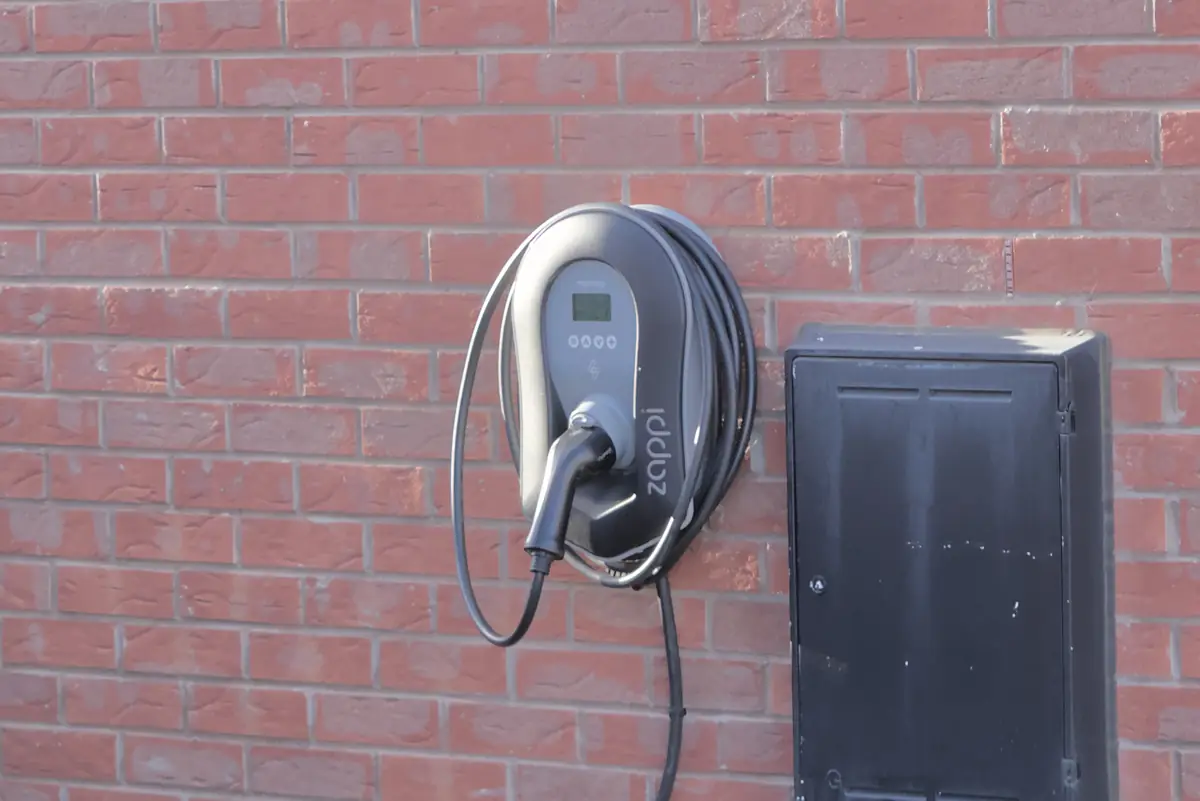
EV charger installation with Kingsmead Solar starts from £899 for a 7kW smart charger on a standard install, fitted by our own electricians and usually finished in half a day. We check your supply, earthing and consumer unit first, notify your network operator, and if you have solar we can fit a charger that tops up the car from your own surplus power.
- From £899 for a 7kW charger, standard install
- 7kW is the fastest a normal single-phase home supply can run
- Up to £500 government grant for renters and flat owners, until 31 March 2027
- Half a day for most installs
What a standard install includes
- a 7kW (32 amp) tethered or untethered smart charger from a reputable maker
- a dedicated circuit from your consumer unit with its own protection
- a short external cable run to a wall close to where you park
- earthing and open PEN fault protection, explained below
- setting up the app, your tariff and the charging schedule
- notifying your distribution network operator and issuing electrical certification
Longer cable runs, cable through a loft or under a floor, groundworks to a detached garage or a post-mounted charger on a driveway are priced at survey. For typical figures across the market, see our guide to EV charger installation cost. Industry prices for an installed home charger run from about £800 to £1,200.
Solar-aware chargers
If you have panels, or are getting them, a solar-aware charger can watch what your home is exporting and send that surplus into the car instead of the grid. On a bright day it can charge purely from sunshine, or blend solar with grid power so the car still charges at a useful rate. The charger needs a clamp on your meter tails to read exports, which we fit as part of the job.
Combined with a battery and a time-of-use tariff, a charger can also be set to charge overnight at off-peak rates. The government estimates home charging can cost as little as 2p per mile. See solar panels with battery if you want the whole setup.
Where the charger goes
The best spot is on a wall close to where the car's charging port sits when you park, so the cable reaches without stretching across a path. We usually mount the charger on the front or side wall of the house, or inside or on a garage, at a comfortable height. Tethered chargers come with a fixed cable, typically 5 to 7.5 metres, and untethered ones have a socket for your own cable. If there is no suitable wall, a charger can go on a post on the driveway, fed by an underground armoured cable. We agree the position with you at survey.
What happens on install day
Our electrician arrives, confirms the position and cable route with you, and fits the charger and any load management clamp. Your power is off for a short time while the new circuit is connected to the consumer unit. Then we test the circuit and earthing, confirm the open PEN protection works, connect the charger to your Wi-Fi or its own mobile connection, and set up the app with your tariff. Before we leave, we plug in your car if it is at home and check it charges.
Earthing and open PEN protection
Most homes in England have a PME earthing arrangement, where the supply's neutral and earth share a conductor. If that shared conductor breaks in the street, a rare fault called an open PEN, metal parts connected to earth can become live. A car sitting on a driveway, touching the ground, is exactly where that matters.
The wiring regulations, BS 7671, do not allow an outdoor charger to rely on PME earthing alone. Compliant options include a charger with built-in open PEN detection that disconnects the car, a separate protection device, or an earth rod. Most modern chargers have the protection built in, and we test and record it on every job.
Your consumer unit and supply
A 7kW charger draws 32 amps for hours at a time, which is a lot for a home supply. Before we fit, we check:
- Your main fuse: commonly 60, 80 or 100 amps. With a charger, electric shower and oven running together, a smaller fuse can be overloaded, so we fit load management that turns the charger down when the house is busy.
- Your consumer unit: it needs a spare way and suitable protection. Older fuse boards may need replacing, which industry figures put at £400 to £800 extra.
- Cable route: the shortest safe route from the consumer unit to the charger, and how it passes through walls.
Smart charging rules
Every home charger sold in Great Britain must meet the Electric Vehicles (Smart Charge Points) Regulations 2021. That means the charger is smart and connected, meets security requirements, and comes with a default schedule that avoids peak hours (8am to 11am and 4pm to 10pm on weekdays), which you can change in the app. Scheduled charges also start after a short random delay of up to 10 minutes, so thousands of chargers do not switch on at the same second when cheap rates begin.
Grants for flats and renters
The government's EV chargepoint grant pays up to £500 towards a home charger if you rent your home, or own and live in a flat, and have private off-street parking. A separate grant of up to £500 covers households with only on-street parking who fit a cross-pavement solution. Both run until 31 March 2027, and you apply through the government's Find a Grant service after buying the charger. Owners of freehold houses with a driveway are not eligible. Landlords can claim under a separate scheme.
Getting solar too: fitting the charger on the same visit as panels shares the survey and the electrical work, and lets us size the solar system around your car's mileage. See solar panel installation.
Pairing a charger with a battery? Our home battery storage page explains how the two work together on a time-of-use tariff. When you are ready, get a free quote.
Sources: gov.uk EV chargepoint grants; gov.uk grant boost announcement; Electric Vehicles (Smart Charge Points) Regulations 2021; IET Wiring Matters on BS 7671 and EV charging; Heatable EV charger costs.