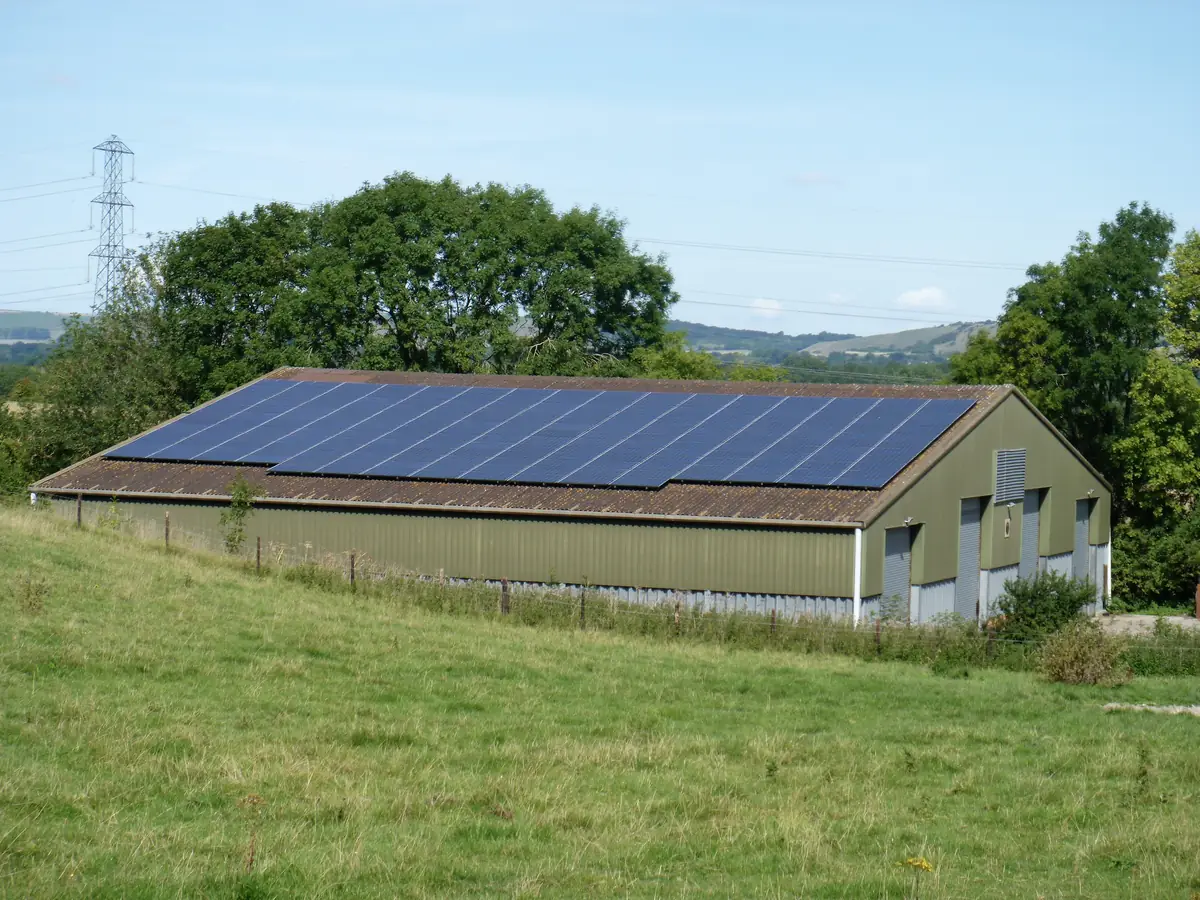
Commercial solar panels make most sense where a site uses electricity during the day, because almost everything the roof makes is used on site at your full business tariff rather than exported. We design and install commercial systems for offices, warehouses, farms and schools across England, typically at £900 to £1,300 per kW for 10 to 100kW, with the structural survey, G99 application and certification included.
- £900 to £1,300 per kW for 10 to 100kW, priced per site
- 100% first-year relief through the £1m Annual Investment Allowance
- 0 business rates on qualifying onsite solar until 31 March 2035
- G99 network application prepared and managed by us
Who commercial solar suits
Offices and shops
Lighting, IT, air conditioning and refrigeration run through the working day, which lines up well with solar output. Even a modest roof can cover a useful share of daytime load.
Warehouses and industrial units
Large, unshaded roofs give room for big arrays at the lowest cost per kW. Cold stores, workshops with machinery and sites with electric forklifts use power steadily, and fleets moving to electric vans can charge from the same roof. We also fit EV chargers for workplaces.
Farms
Dairy, poultry and grain drying are heavy daytime users. Farm buildings often have wide, low-pitched roofs, and where the roof is not suitable a ground-mounted array on unused land is an option. Many farms have a three-phase supply, which helps with larger systems.
Schools and community buildings
Schools use most power in term-time daylight hours. Summer output falls partly in the holidays, so we model export carefully and look at whether a battery or a better export tariff improves the numbers.
Survey and structural checks
Commercial roofs vary far more than houses, so every project starts with a detailed survey. We look at:
- Structure: purlin spacing, steel or timber frame, and spare load capacity. Where needed we commission structural calculations from an engineer before we design.
- Roof covering: profiled steel, standing seam, fibre cement, membrane or tile. Older fibre cement sheets may contain asbestos and are checked before anyone works on them.
- Remaining roof life: panels last decades, so a roof that needs replacing in five years should be replaced first.
- Access and safety: fragile rooflights, edge protection and how we work without disrupting your business.
- Electrical supply: single or three phase, main switchboard capacity and where the inverters go.
- Half-hourly data: if you have it, your consumption data lets us size the system to what you actually use.
If you lease the building, you will need the landlord's consent, and we can provide drawings and structural reports for that conversation.
Network connection: G99
Almost all commercial systems exceed the small-scale G98 limit, so they need a G99 application to your distribution network operator before installation. The DNO assesses whether the local network can take the export. Sometimes it asks for export limitation, where the inverters are capped so the site never exports above an agreed level, and on constrained networks it can quote for reinforcement. We prepare the application, handle the DNO's questions and build the timescale into your programme.
Tax and business rates
Solar panels are classed as special rate expenditure for capital allowances. In practice that gives three routes:
- Annual Investment Allowance: any business can deduct 100% of qualifying spend in the year it is incurred, up to £1 million a year.
- Full expensing, special rate: companies can claim a 50% first-year allowance on special rate assets, with the rest in the special rate pool. The AIA is usually better for systems under £1m.
- Writing down allowance: without either, special rate assets are written down at 6% a year.
Onsite renewable generation and storage in England is exempt from business rates from 1 April 2022 to 31 March 2035, so a new array should not raise your rateable value. Commercial installations carry VAT at the standard rate, which VAT-registered businesses normally reclaim. Take advice from your accountant on your own position.
Selling what you do not use
Businesses can sell surplus power under the Smart Export Guarantee for systems up to 5MW, or through a private export agreement. Systems up to 50kW qualify through their MCS certificate, and larger ones through Ofgem's ROO-FIT accreditation, which we help you apply for. For most commercial sites, though, the value is in the power used on site, which is why we size systems around your daytime load rather than the biggest array the roof can hold.
How we deliver commercial projects
Our own employed teams install commercial systems, the same people who fit our home systems, working to agreed site rules, method statements and risk assessments. We give you a fixed written price per site after survey, a programme with dates, and a named contact through to handover. Every system is monitored remotely, and our 10-year insurance-backed workmanship warranty applies. Read more about how our installation process works and our warranties, or look at solar panel costs for homes and smaller buildings.
Adding storage: sites with high evening loads, or schools with long holidays, can use a commercial battery to shift solar into the hours it is needed. We model both options at survey.
To start, contact our team with your address and a recent electricity bill, and we will arrange a site survey.
Sources: HMRC Capital Allowances Manual CA22335, solar panels; gov.uk permanent full expensing; gov.uk capital allowance rates and pools; Valuation for Rating (Plant and Machinery) (England) (Amendment) Regulations 2022; Ofgem Smart Export Guarantee.